Sustainable Impact Annual Report
Rotary Community Corps

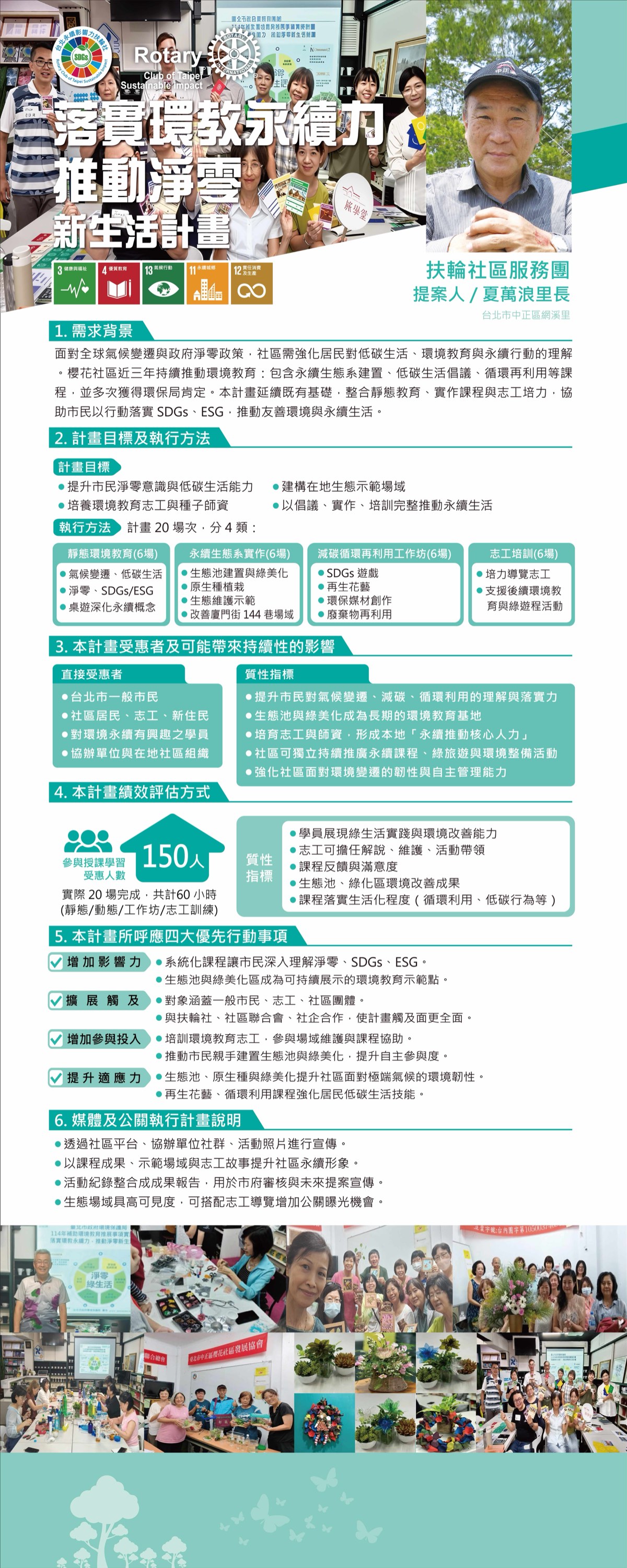
Realizing Environmental Education for Sustainability: Promoting a Net-Zero New Lifestyle Project

Proposer · Borough Chief Hsia Wan-lang (Wangxi Borough, Zhongzheng District, Taipei City)

3 Good Health and Well-being 4 Quality Education 11 Sustainable Cities and Communities 12 Responsible Consumption and Production 13 Climate Action
Realizing Environmental Education for Sustainability: Promoting a Net-Zero New Lifestyle Project

1 · Background and Need

In the face of global climate change and the government's net-zero policy, communities need to strengthen residents' understanding of low-carbon living, environmental education, and sustainable action. The Sakura community has continued to promote environmental education over the past three years, including building sustainable ecosystems, advocating for low-carbon living, and offering courses on the circular reuse of materials, earning recognition from the Environmental Protection Bureau on multiple occasions. Building on this foundation, the project integrates classroom education, hands-on courses, and volunteer empowerment to help citizens put the SDGs and ESG into action, advancing an environmentally friendly and sustainable way of life.
2 · Project Goals and Implementation Methods

Project Goals

Implementation Methods (20 sessions in 4 categories)

CategorySessionsContent
Classroom environmental education6Climate change and low-carbon living; net-zero, SDGs/ESG; board games to deepen sustainability concepts
Sustainable ecosystem practice6Building ecological ponds and greening; native species planting; ecological maintenance demonstrations; improving the site at Lane 144, Xiamen Street
Carbon reduction and circular reuse workshops6SDGs games; recycled floral art; eco-material creations; waste reuse
Volunteer training6Empowering docent volunteers; supporting follow-up environmental education and green tour activities

3 · Beneficiaries and Potential Lasting Impact

Direct Beneficiaries

Qualitative Indicators

4 · Performance Evaluation Methods

Quantitative Indicators

Number of beneficiaries
150
Sessions
20
Total hours
60
Course structure
Classroom / hands-on / workshops / volunteer training

Qualitative Indicators

5 · Alignment with Rotary's Four Priorities

Increase Our Impact

Expand Our Reach

Enhance Participant Engagement

Increase Our Ability to Adapt

6 · Media and Public Relations Plan