Sustainable Impact Annual Report
Rotary District Grant

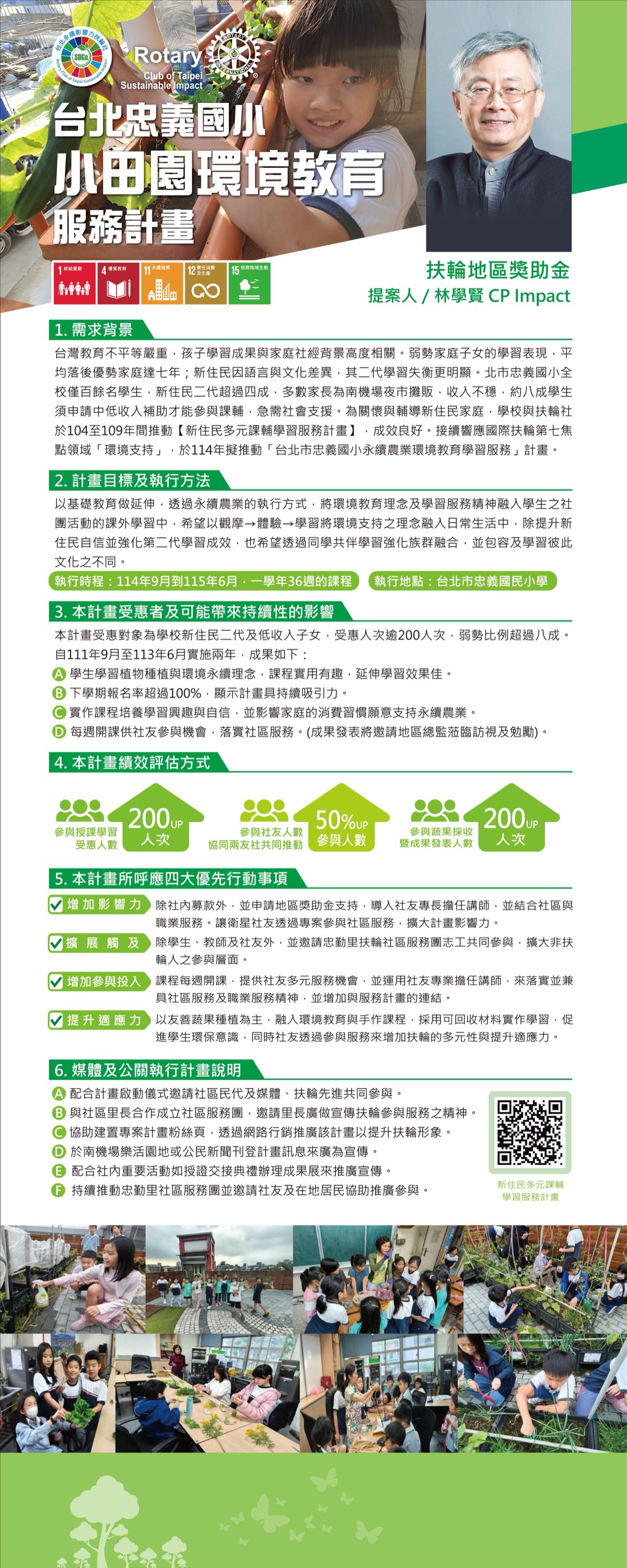
Taipei Zhongyi Elementary School Little Farm Environmental Education Service Project

Lin Hsueh-hsien (CP)
Charter Club President · Builder of Value-Driven Spaces

He founded the Rotary Club of Taipei Sustainable Impact, making "ensuring members' vocational service is recognized" the core purpose of the Club's existence.

Read the full profile →
1 No Poverty 4 Quality Education 11 Sustainable Cities and Communities 12 Responsible Consumption and Production 15 Life on Land
Taipei Zhongyi Elementary School Little Farm Environmental Education Service Project

1 · Background and Need

Educational inequality in Taiwan is severe, and a child's learning outcomes are highly correlated with the family's socioeconomic background. On average, children from disadvantaged families lag behind those from advantaged families by as much as seven years. For new immigrant families, language and cultural differences make the second generation's learning imbalance even more pronounced.

Taipei Zhongyi Elementary School has only just over a hundred students in total, more than 40% of whom are second-generation new immigrants. Most of their parents are vendors at the Nanjichang Night Market with unstable incomes, and about 80% of the students must apply for low- and middle-income subsidies to participate in after-school tutoring. The need for social support is urgent.

To care for and support new immigrant families, the school and the Rotary Club jointly ran the "New Immigrant Diversified After-School Learning Service Project" between 2015 and 2020, with good results. Continuing to respond to Rotary International's seventh area of focus, "supporting the environment," in 2025 the Club plans to launch the "Taipei Zhongyi Elementary School Sustainable Agriculture Environmental Education Learning Service" project.

2 · Project Goals and Implementation Methods

Building on basic education, the project integrates environmental education and the spirit of learning service into students' extracurricular club activities through sustainable agriculture. Following an observation, experience, learning sequence, it aims to weave the concept of supporting the environment into daily life. In addition to boosting the confidence of new immigrants and strengthening the second generation's learning outcomes, the project also seeks to strengthen ethnic integration through peer learning, and to foster mutual acceptance and understanding of different cultures.

Implementation period
September 2025 to June 2026
One academic year (36 weeks)
Location
Taipei Zhongyi Elementary School
Course method
Sustainable agriculture practice plus food and agriculture education
Support structure
Jointly promoted with two sister clubs

3 · Beneficiaries and Lasting Impact

The beneficiaries of this project are second-generation new immigrants and children from low-income families at the school. The number of beneficiaries exceeds 200, with the proportion of disadvantaged participants over 80%. Implemented over two years from September 2022 to June 2024, the results are as follows:

4 · Performance Evaluation Methods

Evaluation ItemQuantitative Indicator
Number of beneficiaries participating in classes200+
Number of participating membersJointly promoted with two sister clubs, 50%+ participation
Number participating in harvest and results presentation200+

5 · Alignment with Rotary's Four Priorities

Increase Our Impact

In addition to fundraising within the Club, the project applies for a District grant for support, brings in members' professional expertise as instructors, and combines community and vocational service. Satellite club members participate in community service through the project, expanding its impact.

Expand Our Reach

Beyond students, teachers, and members, volunteers from the Zhongqin Borough Rotary Community Corps are also invited to participate, broadening the involvement of non-Rotarians.

Enhance Participant Engagement

Weekly classes offer members diverse service opportunities, and members' professional skills are used for teaching, putting both community service and vocational service into practice while strengthening their connection to the project.

Increase Our Ability to Adapt

Centered on cultivating friendly fruits and vegetables, the project incorporates environmental education and hands-on courses. Using recyclable materials for practical learning, it promotes students' environmental awareness, while members increase Rotary's diversity and adaptability through their service.
6 · Media and Public Relations Plan