Impact Map
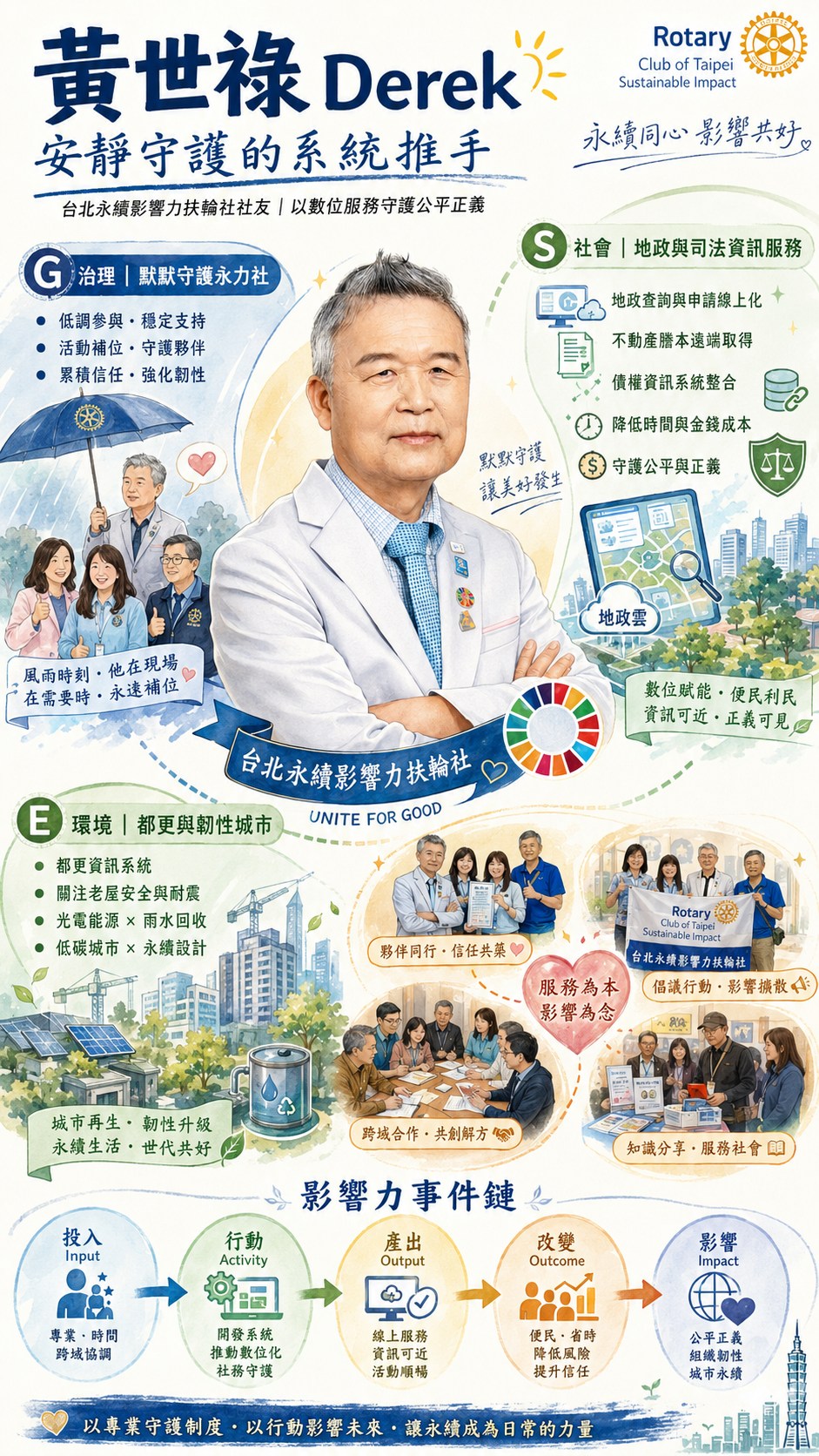
That day, on a visit to an organic farm, the sky darkened quickly. On the last stretch of the path between the fields, a fine rain suddenly began to fall, and the ground quickly turned muddy. The Club President was still walking ahead, explaining as he went, while everyone watched their footing and tried to follow along. In an instant, without a warning and without interrupting anyone, he simply stepped forward and raised the umbrella higher, letting the rain land on the umbrella rather than on the person leading the way.
He was not "doing a good deed." He was "holding a rhythm": keeping the speaker from being thrown off by the rain, keeping the group from being scattered by the weather, keeping the whole itinerary from losing order over a small mishap.
This low-key yet precise attentiveness is exactly his consistent style.
When speaking of his own work, he rarely uses elegant words. He will say "the system has to be usable," but listen long enough and you understand he cares not about the feature list, but about how a system is truly used by people. He has long been involved in information system services related to land administration and the judiciary. On the surface, the work is "inquiry" and "application," but in essence it is about reducing institutional friction, making rights easier to understand, assert, and realize.
Take the field of land administration as an example. In the past, applying for transcripts or looking up information often meant taking leave, riding the bus, drawing a number ticket, queuing, waiting, and making another trip. For those familiar with the process it is merely a nuisance; for those unfamiliar, a single misstep can mean several extra trips.
After he took part in building the nationwide online inquiry and application processes, the distance of the system was shortened. There was no need for arduous travel, no need to bear procedural friction, and information transparency became a daily convenience.
In systems related to judicial creditor protection, his focus points even more directly at "letting rights land." Creditor protection involves procedures, proof, inquiry, and traceability, and information gaps often amplify disadvantage. When a system organizes key information and procedural context more clearly and makes inquiry more immediate, many matters that once required "someone who knows the ropes" to handle smoothly can return to the system itself: following the rules, speaking through evidence. Such transparency and traceability accumulate over the long term into social trust.
In more everyday language: when data can be found, processes can be understood, and evidence can be connected, the public is less likely to miss out on their rights because they "do not know what to do," and less likely to go back and forth at the counter because information is unclear. When the threshold of the system is lowered, fairness has a chance to become everyday.
He rarely calls any of this "sustainability." But if we look back through an ESG lens, his impact is in fact very concrete, accumulated through one small change after another:
These changes may seem scattered, but together they point to one thing: making the system more accessible, making rights more attainable, making daily life less burdened by friction.
In the Club he is often the same presence: he does not take the floor, does not show off, but fills the key gaps. He pulls discussion back to the feasible, thinks processes through more thoroughly, and turns "passion" into "a way that can operate over the long term."
He influences people not through volume, but through reliability that puts others at ease.
Back to that rain. The umbrella was not large, but he held it steadily.
What he held up was not only the rain over the Club President's head, but a trust in systems and order, letting people believe that fairness can be designed, justice can be realized, and daily life can become less effortful and closer to each person.