Sustainable Impact Annual Report
Rotary Club Grant

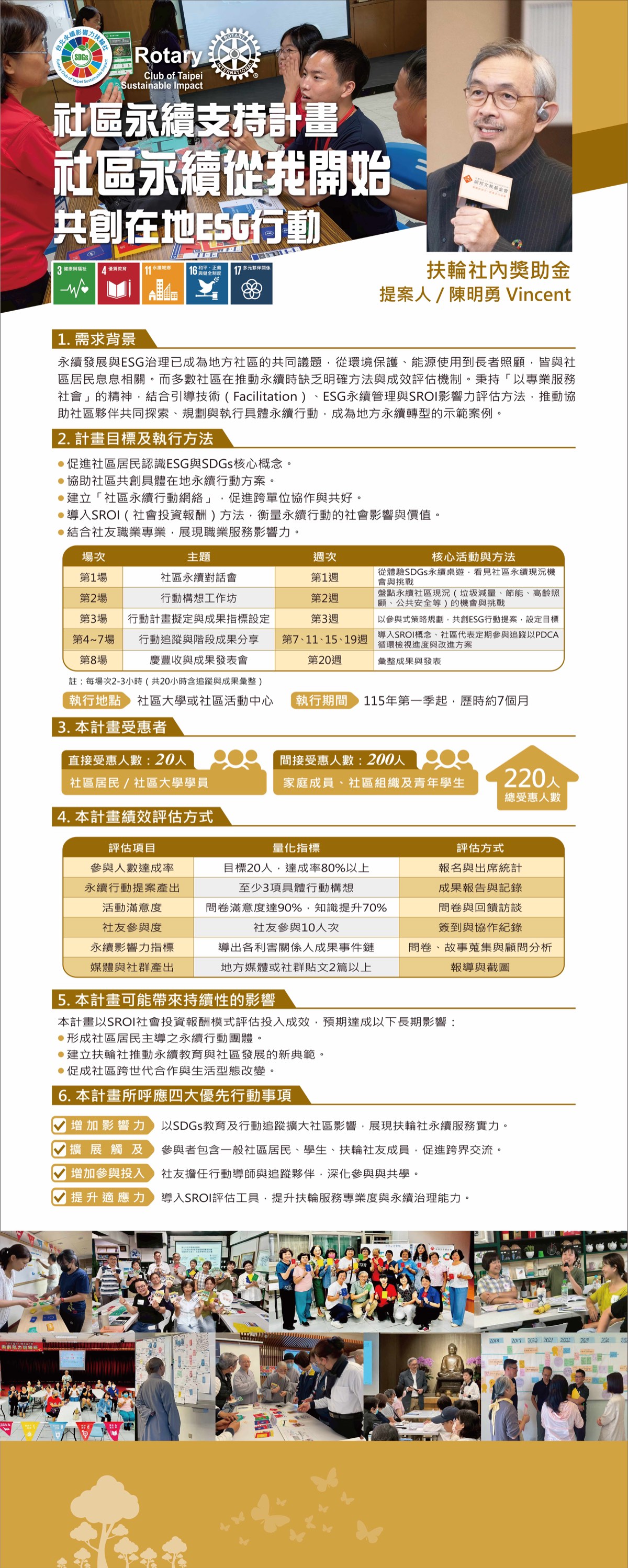
Community Sustainability Support Project: Co-Creating Local ESG Action

Chen Ming-yung (Vincent)
Facilitator · Lead Author of the Report

He uses the methodologies of facilitation, SROI, and ESG to connect the dialogue among the community, businesses, and members.

See full profile →
3 Good Health and Well-being 4 Quality Education 11 Sustainable Cities and Communities 16 Peace, Justice and Strong Institutions 17 Partnerships for the Goals
Community Sustainability Support Project: Co-Creating Local ESG Action

1 · Background and Need

Sustainable development and ESG governance have become shared issues for local communities, from environmental protection and energy use to elderly care, all closely tied to community residents. Yet most communities lack clear methods and effectiveness-evaluation mechanisms when promoting sustainability. Upholding the spirit of "serving society through expertise," this project combines facilitation, ESG sustainability management, and the SROI (Social Return on Investment) impact evaluation method to help community partners jointly explore, plan, and carry out concrete sustainability actions, becoming a demonstration case of local sustainable transformation.

2 · Project Goals and Implementation Methods

SessionThemeWeekCore Activities and Methods
Session 1Community Sustainability DialogueWeek 1Through the SDGs sustainability board game, see the community's current sustainability opportunities and challenges
Session 2Action Ideation WorkshopWeek 2Take stock of the opportunities and challenges of the sustainable community's current state (waste reduction, energy saving, elderly care, public safety, etc.)
Session 3Action Plan Drafting and Outcome Indicator SettingWeek 3Use participatory strategic planning to co-create ESG action proposals and set goals
Sessions 4–7Action Tracking and Phased Results SharingWeeks 7, 11, 15, 19Introduce the SROI concept; community representatives regularly participate in tracking, reviewing progress and improvement plans through the PDCA cycle
Session 8Harvest Celebration and Results PresentationWeek 20Compile and present results

Note: Each session lasts 2–3 hours (20 hours total, including tracking and results compilation).

Location
Community college or community activity center
Period
From Q1 of 2026
Total duration
About 7 months
Methodology
Facilitation + ESG + SROI

3 · Beneficiaries

Total beneficiaries: 220 people

4 · Performance Evaluation Methods

Evaluation ItemQuantitative IndicatorEvaluation Method
Participation achievement rateTarget 20 people, achievement rate over 80%Registration and attendance statistics
Sustainability action proposals producedAt least 3 concrete action ideasResults reports and records
Activity satisfactionSurvey satisfaction reaching 90%, knowledge improvement 70%Surveys and feedback interviews
Member participation10 member participationsSign-in and collaboration records
Sustainability impact indicatorsDeriving outcome event chains for each stakeholderSurveys, story collection, and consultant analysis
Media and social media outputAt least 2 local media or social media postsCoverage and screenshots

5 · Potential Lasting Impact

This project will use the SROI (Social Return on Investment) model to evaluate the effectiveness of its inputs, with the following long-term impacts anticipated:

6 · Alignment with Rotary's Four Priorities

Increase Our Impact

Expand community impact through SDGs education and action tracking, demonstrating the Rotary Club's capacity for sustainable service.

Expand Our Reach

Participants include general community residents, students, and Rotary members, promoting cross-sector exchange.

Enhance Participant Engagement

Members serve as action mentors and tracking partners, deepening participation and co-learning.

Increase Our Ability to Adapt

Introduce SROI evaluation tools to enhance the professionalism of Rotary service and the capacity for sustainability governance.